 Tortue Lodge
Tiny house: the complete guide
Getting started
What is a tiny house?
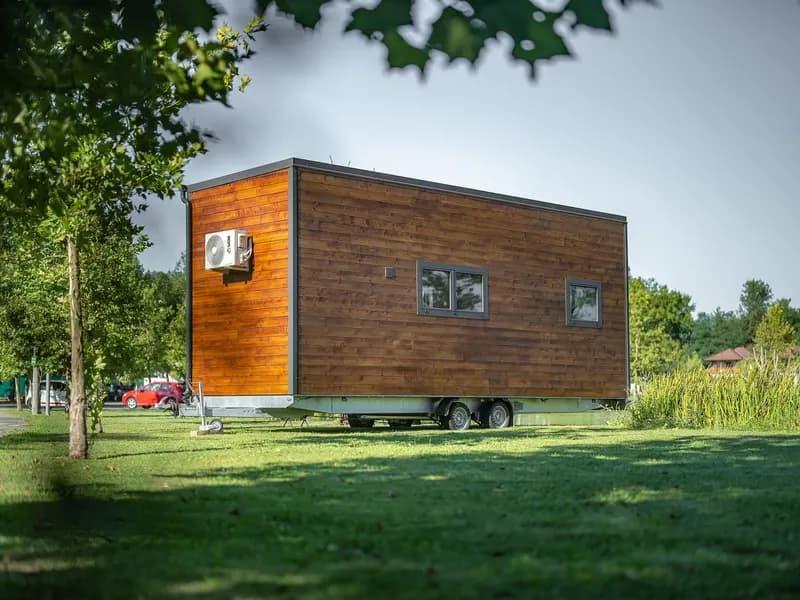
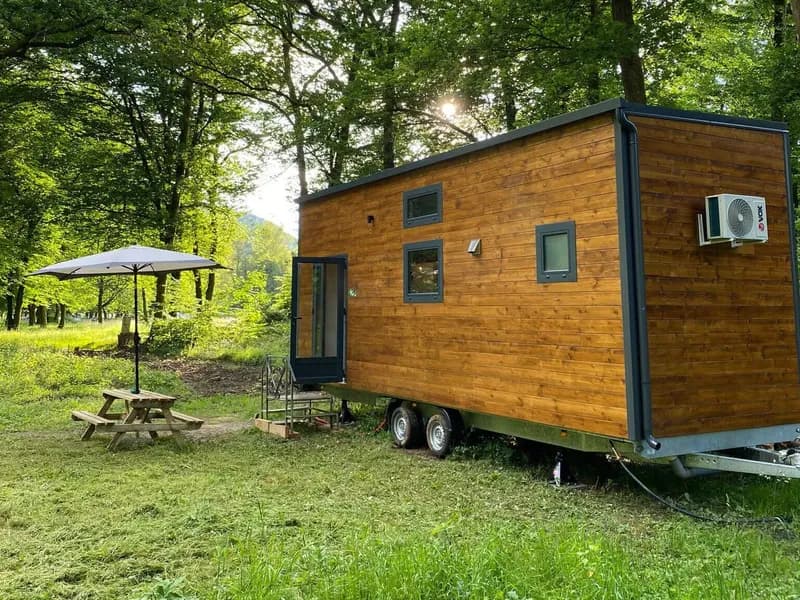
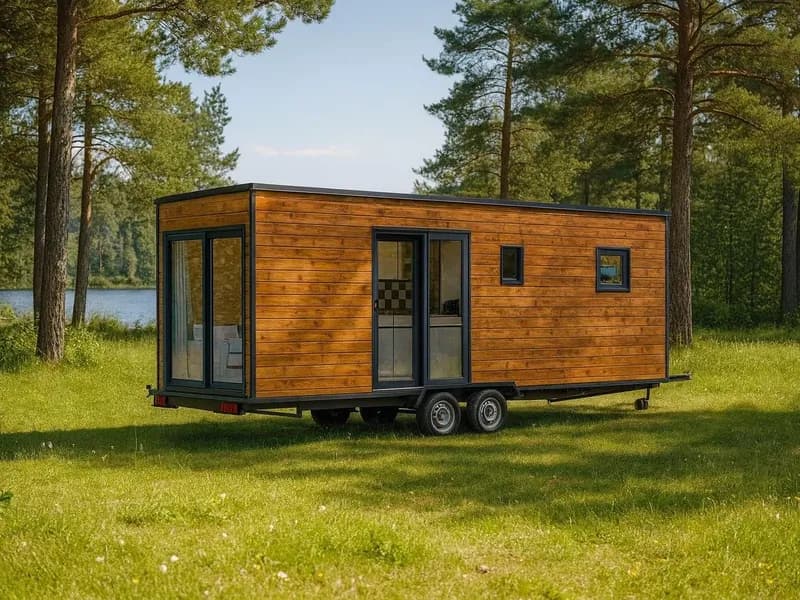
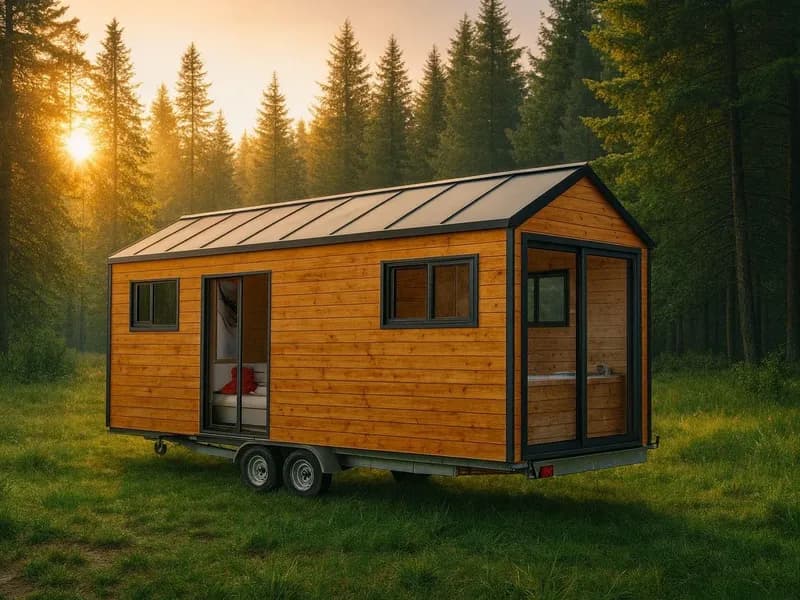
A tiny house is a small home of 15 to 40 m², compact and optimised, most often built on a trailer. As long as it keeps its wheels and its roadworthiness, the French planning code (Code de l’urbanisme) treats it as a caravan. This point of law, not floor area, determines where it can be sited and for how long.
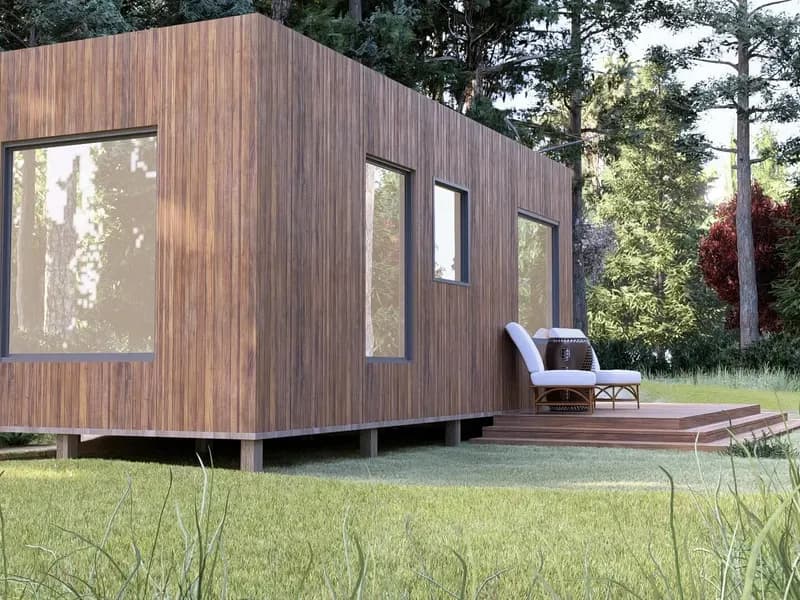
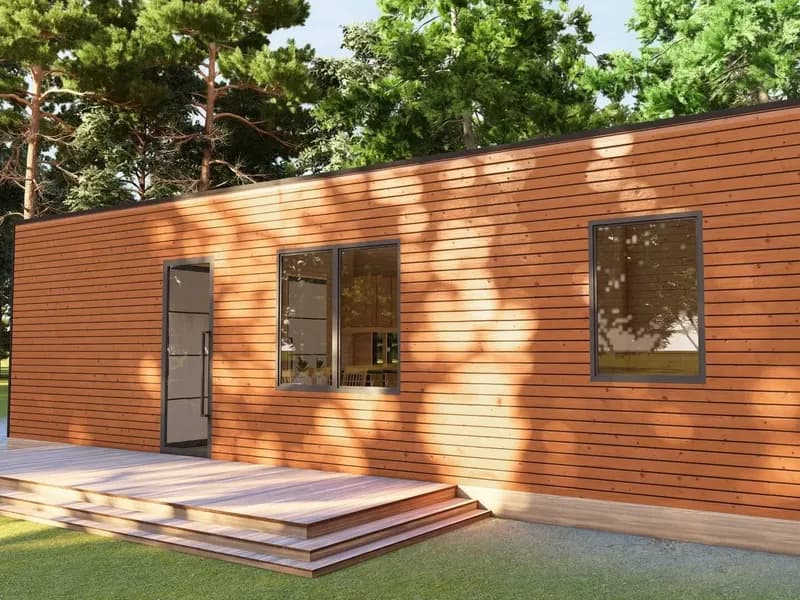
Once it loses its mobility — set on pads, permanently connected — it falls under a different regime: it becomes a demountable dwelling (résidence démontable) or a building, with the corresponding formalities. Understanding these four regimes is the first step in any serious project.
This guide brings together the answers to the questions future owners ask, in the order in which they arise: budget, land, permissions, taxes, daily life, then the technical side. Each short answer links to a detailed guide, with its official sources and the date it was last checked.
Key figures
Five figures to know before you start
- 01€45,720 to €89,640The price range of our models with a published price, excluding transport. Professional models are priced on quote.
- 023 months a yearHow long a tiny house on wheels can be parked on private land without any planning formalities, all periods combined.
- 0320 m²The threshold above which a tiny house set permanently on the ground requires planning permission (permis de construire) rather than a prior declaration (déclaration préalable).
- 042.55 mThe overall width beyond which transport becomes an abnormal load (convoi exceptionnel). It is what shapes the house and limits the thickness of the insulation.
- 0515 to 40 m²The span of our range, from the 20 m² garden studio to the 40 m² dormitory, by way of the 30 m² family models.
Budget
How much does a tiny house cost?
At Tortue Lodge, models with a published price range from €45,720 to €89,640, excluding transport; professional models are priced on quote. On top of this price come delivery, site preparation, utility connections or off-grid equipment, any development tax (taxe d’aménagement) and insurance.
Comparing two offers therefore means comparing their scope, not their figures: what is included varies enormously from one builder to another. The price per square metre, for its part, means little for such small floor areas — the kitchen, the shower room and the services cost almost as much in 15 m² as in 40 m².
See the breakdown on the prices page, and our guide on what the price includes. Financing is through a consumer loan, explained in financing a tiny house.
Land
Where can you put a tiny house?
Most simply on buildable land, in line with the local urban plan (plan local d’urbanisme, PLU). On wheels, the house can stay on private land for up to three months a year without any formalities. In an agricultural or natural zone, permanent living is only possible within a STECAL (a small designated area where building is allowed) delimited by the municipality.
This is the step at which the most projects fail, by far. The classic mistake is to buy cheap land in the belief that the house’s mobility exempts it from planning rules: it does not. Before buying anything, apply for a planning certificate (certificat d’urbanisme) — it is free and valid for 18 months.
Our guides: where to site a tiny house, a tiny house on non-buildable land and a tiny house in your garden.
Permissions
Do you need planning permission?
Not always. On wheels, no formalities are required for up to three months a year on the same plot; after that, a prior declaration. For permanent living in a demountable dwelling, a prior declaration up to a total of 40 m² of floor area (surface de plancher). Set on foundations: a prior declaration from 5 to 20 m², planning permission above that.
These thresholds are the general rules: the PLU may be stricter, and in protected areas the opinion of the Architecte des Bâtiments de France (the state heritage architect) is also required. Processing takes one month for a prior declaration and two months for planning permission for a detached house.
Everything is explained in detail in planning permission or prior declaration and in tiny houses and regulations.
Tax
Which taxes apply to a tiny house?
It all depends on mobility. A tiny house that keeps its wheels and can be moved is subject neither to property tax (taxe foncière) nor to residence tax (taxe d’habitation). Set on foundations, it becomes a taxable building. A development tax, payable only once, may also apply after authorisation.
Nor are there any notary fees: buying a house on wheels is not a property sale. Income from letting it out, on the other hand, is taxable like any other rental income.
The details, with the legal texts and the rates, are in our guide property tax, residence tax and development tax.
Living
Can you live in a tiny house all year round?
Yes, on two conditions. Legally, caravan status is intended for leisure: permanent living falls under demountable dwellings, which are permitted wherever the PLU allows them. In terms of comfort, everything comes down to three things — insulation, ventilation and heating — which are decided before ordering.
Day-to-day life, for its part, takes organisation: storage is designed along with the house, a place for the laundry has to be planned, and privacy comes from where the beds are placed. When several people live together, these matters count for more than the stated floor area.
See living in a tiny house all year round, living as a family and pros and cons.
Construction
How is a tiny house built?
On a trailer chassis, a timber frame takes the insulation, a breather membrane, the cladding and the roofing. The critical point is the floor: on a trailer, it is exposed to the open air, with no solid ground beneath it to temper heat exchange. Our houses are insulated with rock wool, at least 10 cm in the walls and 14 cm under the floor of the Skywood.
No thermal regulation applies to a tiny house on wheels: RE2020 (the French energy and environmental building regulation) covers the construction of buildings that require authorisation. In other words, no minimum performance is guaranteed — it is up to the buyer to ask for the thicknesses, the materials and the type of ventilation, and to have them written into the quote.
Our technical guides: insulation, damp and ventilation, heating, utility connections and off-grid tiny houses.
Choosing
How do you choose your model?
In this order: the use, mobile or fixed status, the land, and only then the floor area. Allow 15 m² for two, 20 m² for a separate bedroom, 30 m² for a family with two bedrooms on mezzanines (sleeping lofts), 35 m² for two ground-floor bedrooms. A mezzanine gains floor area but costs you in everyday comfort.
Two limits shape the house: a total weight of 3,500 kg to stay within a B licence, and an overall width of 2.55 m to avoid an abnormal load. Every centimetre of insulation comes out of the interior width: this is the central trade-off in the design.
See which tiny house to choose, the catalogue and, if you are comparing several types of home, tiny house, chalet, container or caravan.
Transport
How is a tiny house delivered?
By road, towed or carried. The licence you need depends on the maximum authorised weight of the combination: B licence up to 3,500 kg, B96 endorsement up to 4,250 kg, BE licence above that. A trailer over 500 kg must be registered. Beyond 2.55 m wide, it becomes an abnormal load.
Access to the site is the first thing to check, even before the model: width of the track, turning radius, slope, gate, low branches and overhead lines. An impossible delivery is discovered too late.
Letting and investing
Can you let out a tiny house?
Yes, and it is a common use. But a tiny house is not furnished tourist accommodation (meublé de tourisme) within the meaning of the official classification, and hosting guests on a plot of land is subject to rules specific to leisure accommodation. So you need land that allows it before thinking about returns.
The income is taxable, the insurance must cover rental use, and the model you choose is not the same as for a main residence: what matters is the sleeping arrangements, the shower room and ease of maintenance.
See letting your tiny house and, for professional use, professional tiny houses.
Lifespan
How long does a tiny house last?
A well-designed, well-maintained tiny house lasts as long as a timber-frame house. Its longevity depends on protecting the timber from moisture, on ventilation and on the condition of the trailer. On the other hand, it depreciates: it is an equipment purchase, not a property investment.
At resale, what holds the value is a compliant trailer in good condition, a maintenance log, repairable equipment and complete documentation of the build.
See lifespan, maintenance and resale, buying second-hand and building it yourself or having it built.
The six sections of the guide
- 01RegulationsLegal status, planning permission and prior declaration, non-buildable land, taxes.
- 02SitingChoosing your land, siting in a garden, professional use.
- 03BuyingChoosing your model, understanding the price, financing, transport, insurance, buying second-hand.
- 04BuildingSelf-build, kits, weathertight shell or turnkey house.
- 05TechnicalInsulation, damp and ventilation, heating, utility connections, off-grid living.
- 06LivingLiving all year round, as a family, pros and cons, maintenance, letting.
Frequently asked questions
What is a tiny house?
A tiny house is a small home of 15 to 40 m², compact and optimised, most often built on a trailer. As long as it keeps its wheels and remains roadworthy, the Code de l’urbanisme (French planning code) treats it as a caravan, which determines where and for how long it can be sited.
How much does a tiny house cost?
At Tortue Lodge, models with a published price range from €45,720 to €89,640, excluding transport; models for professional use are priced on quotation. On top of this price come delivery, site preparation, utility connections, any development tax and insurance. The breakdown is on the prices page.
Do you need planning permission for a tiny house?
Not for a tiny house that stays on wheels. If it is fixed to the ground, the general rules apply: a prior declaration (déclaration préalable) from 5 to 20 m², planning permission (permis de construire) above 20 m². The PLU (local urban plan) or a protected area may impose stricter rules.
Where can you put a tiny house?
Most simply on buildable land, in line with the local urban plan (plan local d’urbanisme). In an agricultural or natural zone, permanent living is only possible in a STECAL (an area of limited size and capacity) defined by the municipality. A planning certificate (certificat d’urbanisme), free and valid for 18 months, gives the answer for your specific plot.
Does a tiny house pay property tax (taxe foncière)?
Not as long as it keeps its wheels and can be moved: it is then subject neither to property tax nor to council tax (taxe d’habitation). Placed on foundations, it becomes a taxable building. A development tax (taxe d’aménagement) may be due once, on a flat-rate basis of €3,000 per caravan pitch.
Can you live in a tiny house all year round?
Yes, provided you choose the right legal status. Caravan status covers temporary or seasonal leisure occupation. For a permanent home, the Code de l’urbanisme (French planning code) provides for demountable dwellings (résidences démontables, occupied at least eight months a year) or, for a house placed on foundations, the rules that apply to buildings.
Is a tiny house legal in France?
Yes. No law prohibits it, but none defines it either: depending on whether it keeps its wheels, has had them removed or is placed on foundations, it falls under the rules for caravans, demountable dwellings (résidences démontables) or buildings. Each has its own procedures and its own permitted locations.
A project in mind? Let’s talk.
Describe your project in a few steps, or come and see the models at one of our showrooms.
Start my project